
Dual & Non Dual Philosophy
Understanding One of the Most Important Distinctions in Indian Thought
When exploring Indian philosophy, there are two important words to understand:
dualism and non-dualism.
These terms carry far more depth and nuance than they are often given credit for, and their meaning shifts subtly depending on the philosophical tradition in which they are used. Few distinctions have generated more confusion among modern spiritual seekers than the divide between dual and non-dual thought. Yet with a clearer understanding comes something invaluable: a deeper appreciation of the underlying assumptions, aims, and vision of reality that sit at the heart of each school. What can initially seem like a maze of conflicting teachings begins to reveal itself as a coherent landscape, where each tradition is speaking to a different aspect of the human search for truth.
Many people hear phrases like:
"Everything is One."
"You are consciousness."
"The observer and the observed are not separate."
And assume all Indian traditions are pointing toward the same conclusion. They aren't. Especially when it comes to comparing Samkhya and Vedanta.
One of the most illuminating discoveries in my own studies was realising that Indian philosophy contains multiple, sophisticated, and sometimes contradictory views about the nature of reality, consciousness, and the self.
This wasn't disappointing. It was liberating. Because suddenly the contradictions I'd encountered across yoga classes, spiritual books, retreats, teachers, and traditions began making sense. Different teachers weren't necessarily disagreeing because one was right and another was wrong. Often, they were speaking from entirely different philosophical foundations. And nobody had told me - partly because I think many of these teachers don’t know either.
Understanding the difference between dual and non-dual philosophy became one of the keys that helped organise what had previously felt like a sprawling maze of spiritual ideas.
The Fundamental Question
At the heart of this discussion lies a deceptively simple question:
What is the relationship between consciousness and reality?
Or put another way:
Is there ultimately a separation between the experiencer and what is experienced?
The answer to that question determines whether a philosophical system tends toward dualism or non-dualism.
What Is Dualism?
Dualism proposes that reality consists of two fundamentally distinct principles.
The exact nature of these principles varies depending on the tradition, but common examples include:
self and world
consciousness and matter
soul and God
observer and observed
spirit and nature
In dualistic systems, these distinctions are real and meaningful. They are not merely appearances. They exist as genuine features of reality.
One of the clearest examples is Samkhya (and its sister Yoga). Samkhya proposes two eternal realities:
Purusha: Pure consciousness.
Prakriti: Nature, matter, mind, emotions, thoughts, body, and the entire manifest universe.
The goal of Samkhya and Yoga is not to merge them. The goal is to clearly distinguish them. Liberation comes when consciousness recognises:
"I am not the movements of nature."
This is dualism.
Two realities.
Two principles.
Two categories.
Forever distinct.
The result of this awakening is liberation from suffering, which, in this paradigm view, comes from misidentifying consciousness with nature. I.e. becoming caught up in movements of the mind, which is inherently transient. The self becomes lost in the inevitable ups and down of nature, which leads to apparent destabilisation of the Self, and therefore suffering.
A Practical Example of Dualism
Imagine standing on a riverbank watching water flow past.
Symbolically, the river is:
thoughts
emotions
sensations
memories
desires
experiences
You are the observer on the bank. The observer remains distinct from what is observed. This is a profoundly useful perspective.
In fact, much of meditation practice is built upon this insight.
You are not your thoughts. You are aware of your thoughts.
You are not your emotions. You are aware of your emotions.
This creates space. Freedom. Discernment.
And psychologically, it can be transformative.
What Is Non-Dualism?
Non-dualism begins with the same observation but follows it further.
It asks:
If everything appears within awareness, where exactly is the boundary between awareness and experience?
And this is where things become very interesting.
In non-dual traditions, the apparent separation between observer and observed is ultimately reconsidered.
Not denied. Not ignored. Investigated.
The Sanskrit term often associated with this view is:
Advaita (as in Advaita Vedanta)
Literally:
"Not Two."
The claim is not that there is "One thing." The claim is that reality is not fundamentally divided in the way we habitually assume.
The distinction between self and other, subject and object, observer and observed may be useful practically, but ultimately does not describe the deepest nature of reality.
A Practical Example of Non-Duality
Imagine watching a movie.
On the screen characters appear, conflict appears, love appears, loss appears, entire worlds appear…Yet every image is made of the same screen.
The screen remains present throughout every scene. Advaita Vedanta uses similar examples repeatedly.
Thoughts appear. Sensations appear. The body appears. The world appears. Yet all are known within awareness.
And when examined deeply:
Can anything ever be experienced outside awareness?
The non-dual traditions invite us to investigate this directly. Not as a belief. As an experiment and direct personal experience.
Why This Difference Matters
Many modern seekers unknowingly mix dual and non-dual teachings together. This can create confusion - it certainly did for me.
For example:
A dualistic teacher may say:
"Become the witness."
A non-dual teacher may say:
"Even the witness is being witnessed."
Both statements make sense within their respective frameworks. But they are not saying the same thing. One is cultivating separation and the other is investigating whether separation ultimately exists.
Without philosophical context, these teachings can seem contradictory. With context, they become beautifully coherent. This is the importance of understanding the terms dual and non dual when investigating a system of Indian philosophy.
The Evolution of Indian Philosophy
One reason this distinction is so important is that many Indian traditions developed through dialogue with one another.
They were not isolated systems and were engaged in centuries of philosophical debate. With all of the systems stemming from the same source texts of the Vedas and Upanishads with varied interpretation.
Questions such as:
What is consciousness?
What is liberation?
Is the self real?
Is the world real?
Does God exist?
What is the relationship between awareness and matter?
were discussed with extraordinary sophistication. Understanding dualism and non-dualism helps us understand why these schools arrived at different conclusions.
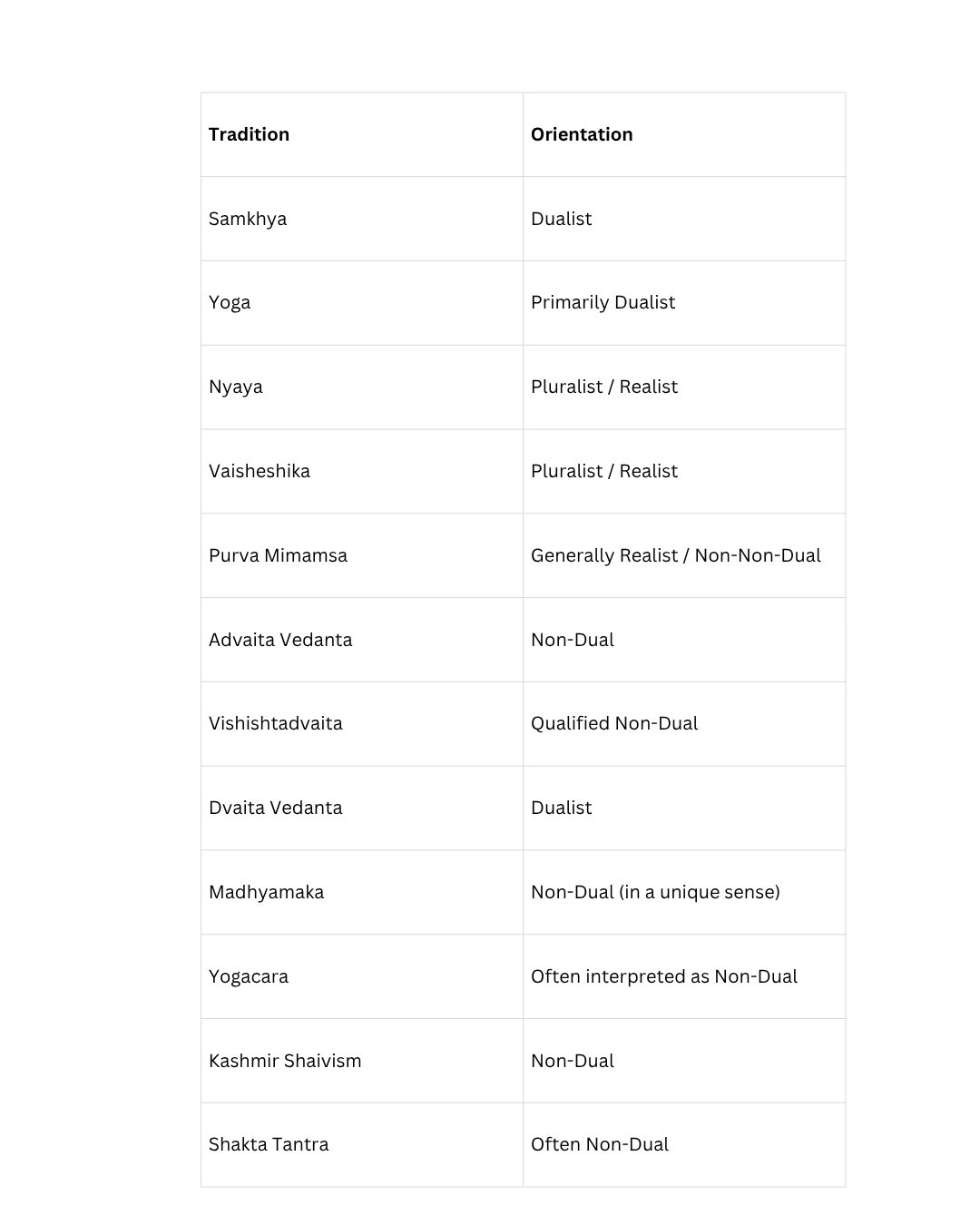
Where the Major Indian Philosophies Sit
Before diving into the list below, it is important to understand that these categories are sometimes simplified.
Many traditions contain multiple interpretations, and some occupy positions that are neither strictly dual nor strictly non-dual.
Still, the following overview provides a useful map.
What becomes clear is that Indian philosophy contains a vast spectrum of positions rather than a single unified worldview.
Which One Is Correct?
This is usually the question people ask next.
But I think it may be the wrong question.
Because each framework offers something valuable.
Dualistic systems excel at:
psychological clarity
meditation practice
self-observation
discernment
Non-dual systems excel at:
investigating identity
exploring consciousness
dissolving existential separation
questioning assumptions about reality
In many ways, they can be seen as complementary.
Many practitioners spend years cultivating the witness through Yoga and Samkhya before exploring the non-dual inquiry of Vedanta.
One prepares the ground. The other asks what remains when the ground itself is examined.
This is certainly my experience. And while I now subscribe to Advaita Vedanta wholeheartedly, it does not dispense the ongoing usefulness of Yoga and Samkhya. In fact, I couldn't have come to understanding Vedanta without that preparation.
Why This Changed Everything for Me
For years I encountered teachings that seemed to contradict one another. One teacher spoke about witnessing and another spoke about oneness.
One emphasised self-development and another emphasised the illusion of the separate self.
One spoke of consciousness and nature and another spoke of only consciousness.
The more I studied, the more confusing it initially became. Until I discovered the broader philosophical landscape, then everything began to organise itself.
Instead of trying to force all Indian spirituality into one coherent system, I realised there were multiple systems. Each with different goals. Different assumptions. Different methodologies. Different conclusions. And this made the whole thing simpler.
I no longer needed to reconcile every teaching into a single doctrine. I could appreciate each system for what it was offering. And choose consciously how I wished to engage with it. Moreover, it gave me more clarity of how to utilise each system by understanding its inherent concepts.
The Invitation
Perhaps the most beautiful thing about studying dual and non-dual philosophy is that neither asks for blind belief. Both insist on personal investigation.
Dualism asks:
What happens when you stop identifying with every movement of mind?
Non-dualism asks:
What happens when you investigate the one who claims to be separate from those movements?
Both are profound questions. Both are worth exploring. And both ultimately point us back toward the same place: direct experience.
Not second-hand spirituality. Not inherited dogma. Not philosophical performance. Experience.
Because beyond the arguments, the concepts, the schools, the labels, and the traditions, there remains the simple mystery that inspired all of them:
the undeniable fact that you are here, aware, and participating in existence. In fact, you are existence itself.
And perhaps that is where the real inquiry begins.